Difference between revisions of "Deer lib gen.m"
(→Examples) |
|||
| Line 95: | Line 95: | ||
==Examples== | ==Examples== | ||
| − | The example below | + | The example below loads the parameters from one of the example files and generates a library of 1000 DEER traces. |
% Load the training set parameters | % Load the training set parameters | ||
| Line 111: | Line 111: | ||
noise_line_lib,exchange_lib,parameters]=deer_lib_gen(file_name,parameters); | noise_line_lib,exchange_lib,parameters]=deer_lib_gen(file_name,parameters); | ||
| − | + | One of the resulting DEER traces is shown below. | |
<gallery widths=400 heights=300> | <gallery widths=400 heights=300> | ||
Revision as of 16:26, 22 August 2018
Generates a library of distance distributions and corresponding DEER traces for use in neural network training. Full details are given in our paper on the subject.
Contents
Syntax
    [time_grid,dist_grid,dist_distr_lib,...
     deer_ffact_lib,background_lib,deer_trace_lib,...
     noise_line_lib,exchange_lib,parameters]=deer_lib_gen(file_name,parameters)
Arguments
Required fields of the parameters.* structure:
   min_dist          - lower limit of distance distributions,
                       Angstrom

   max_dist          - upper limit of distance distributions,
                       Angstrom

   max_time          - DEER trace duration, seconds

   max_exch          - maximum exchange coupling, MHz
                       (NMR convention)

   min_exch          - minimum exchange coupling, MHz
                       (NMR convention)

   ntraces           - number of traces you wish to generate

   ndistmax          - maximum number of skewed gaussians
                       in the distance distribution

   npoints           - number of digitisation points in the
                       DEER trace and the distance distribu-
                       tion

   noise_lvl         - RMS noise level as a fraction of the
                       modulation depth

   min_fwhm          - minimum FWHM for a skewed gaussian in
                       the distance distribution, fraction of
                       distance

   max_fwhm          - maximum FWHM for a skewed gaussian in
                       the distance distribution, fraction of
                       distance

   min_skew          - minimum shape parameter for a skewed
                       gaussian in the distance distribution

   max_skew          - maximum shape parameter for a skewed
                       gaussian in the distance distribution

   max_mdep          - minimum DEER modulation depth

   min_mdep          - maximum DEER modulation depth

   max_brate         - maximum background signal decay
                       rate, s^-1

   min_brate         - minimum background signal decay
                       rate, s^-1

   min_bdim          - minimum background dimensionality

   max_bdim          - maximum background dimensionality
Outputs
   time_grid         - time grid (seconds) as a row vector

   dist_grid         - distance grid (Angsrom) as a row vector

   dist_distr_lib    - all distance distributions as a horizonal
                       stack of row vectors

   deer_ffact_lib    - all DEER form factors as a horizonal
                       stack of row vectors

   background_lib    - all background signals as a horizonal
                       stack of row vectors, shifted and scaled
                       to match DEER traces

   deer_trace_lib    - all complete DEER traces as a horizonal
                       stack of row vectors

   noise_line_lib    - all noise tracks as a horizonal
                       stack of row vectors

   exchange_lib      - exchange interaction (MHz), a row vector
                       conataining the value for each example

   parameters        - parameters array as received
If a file name is provided, these variables are written into that file.
Examples
The example below loads the parameters from one of the example files and generates a library of 1000 DEER traces.
	% Load the training set parameters
	run('net_set_any_peaks/netset_params.m');

	% Specify number of traces to produce
	parameters.ntraces=1000;

	% Set the training database name
	file_name='dlg_example_set.mat';

	% Generate the training library
	[time_grid,dist_grid,dist_distr_lib,...
 	deer_ffact_lib,background_lib,deer_trace_lib,...
 	noise_line_lib,exchange_lib,parameters]=deer_lib_gen(file_name,parameters);
One of the resulting DEER traces is shown below.
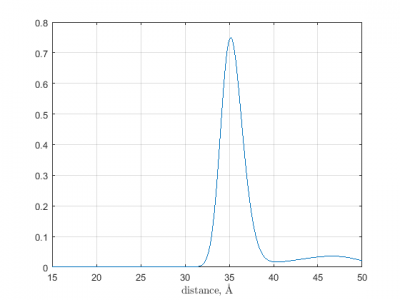
Example distance distribution.
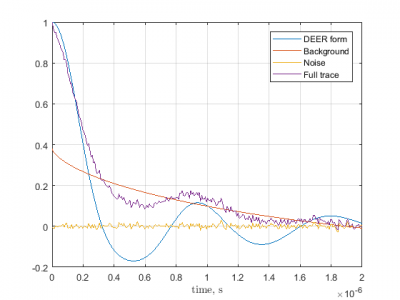
DEER trace and components for example distribution.


Notes
- As the dipolar modulation frequency is a cubic function of the inter-spin distance, a scaling relationship exists betweent the distance range and the duration of the DEER signal.
\[\frac{t_A}{r_A^3}=\frac{t_B}{r_B^3} \]
- An important factor when generating data for training is the dynamic range - the ratio between the longest and shortest distances represented in the training set.
- The training set DEER traces should be sufficiently discretised (parameters.npoints) to reproduce all frequencies present.
See also
netset_curate.m, train_one_net.m
Version 2.2, authors: Ilya Kuprov, Steve Worswick, Gunnar Jeschke
