Difference between revisions of "Deer lib gen.m"
| Line 1: | Line 1: | ||
{{DISPLAYTITLE:deer_lib_gen.m}} | {{DISPLAYTITLE:deer_lib_gen.m}} | ||
| − | Generates a library of distance distributions and corresponding | + | Generates a library of distance distributions and corresponding DEER traces for use in neural network training. Full details are given in our [https://dx.doi.org/10.1126/sciadv.aat5218 paper] on the subject. |
| − | |||
| − | |||
| − | |||
| − | |||
| − | |||
| − | |||
| − | |||
| − | |||
| − | |||
| − | |||
| − | |||
| − | |||
| − | |||
| − | |||
| − | |||
==Syntax== | ==Syntax== | ||
| − | + | [time_grid,dist_grid,dist_distr_lib,... | |
| − | + | deer_ffact_lib,background_lib,deer_trace_lib,... | |
| − | + | noise_line_lib,exchange_lib,parameters]=deer_lib_gen(file_name,parameters) | |
==Arguments== | ==Arguments== | ||
| − | + | Required fields of the parameters.* structure: | |
| − | + | ||
| − | + | min_dist - lower limit of distance distributions, | |
| − | + | Angstrom | |
| − | + | ||
| − | + | max_dist - upper limit of distance distributions, | |
| − | + | Angstrom | |
| + | |||
| + | max_time - DEER trace duration, seconds | ||
| + | |||
| + | max_exch - maximum exchange coupling, MHz | ||
| + | (NMR convention) | ||
| + | |||
| + | min_exch - minimum exchange coupling, MHz | ||
| + | (NMR convention) | ||
| + | |||
| + | ntraces - number of traces you wish to generate | ||
| + | |||
| + | ndistmax - maximum number of skewed gaussians | ||
| + | in the distance distribution | ||
| + | |||
| + | npoints - number of digitisation points in the | ||
| + | DEER trace and the distance distribu- | ||
| + | tion | ||
| + | |||
| + | noise_lvl - RMS noise level as a fraction of the | ||
| + | modulation depth | ||
| + | |||
| + | min_fwhm - minimum FWHM for a skewed gaussian in | ||
| + | the distance distribution, fraction of | ||
| + | distance | ||
| + | |||
| + | max_fwhm - maximum FWHM for a skewed gaussian in | ||
| + | the distance distribution, fraction of | ||
| + | distance | ||
| + | |||
| + | min_skew - minimum shape parameter for a skewed | ||
| + | gaussian in the distance distribution | ||
| + | |||
| + | max_skew - maximum shape parameter for a skewed | ||
| + | gaussian in the distance distribution | ||
| + | |||
| + | max_mdep - minimum DEER modulation depth | ||
| + | |||
| + | min_mdep - maximum DEER modulation depth | ||
| + | |||
| + | max_brate - maximum background signal decay | ||
| + | rate, s^-1 | ||
| + | |||
| + | min_brate - minimum background signal decay | ||
| + | rate, s^-1 | ||
| + | |||
| + | min_bdim - minimum background dimensionality | ||
| + | |||
| + | max_bdim - maximum background dimensionality | ||
==Outputs== | ==Outputs== | ||
| − | |||
| − | + | time_grid - time grid (seconds) as a row vector | |
| − | |||
| − | + | dist_grid - distance grid (Angsrom) as a row vector | |
| − | |||
| − | + | dist_distr_lib - all distance distributions as a horizonal | |
| − | + | stack of row vectors | |
| − | + | deer_ffact_lib - all DEER form factors as a horizonal | |
| − | + | stack of row vectors | |
| − | + | background_lib - all background signals as a horizonal | |
| − | + | stack of row vectors, shifted and scaled | |
| + | to match DEER traces | ||
| − | + | deer_trace_lib - all complete DEER traces as a horizonal | |
| − | + | stack of row vectors | |
| − | |||
| − | |||
| − | |||
| − | + | noise_line_lib - all noise tracks as a horizonal | |
| − | + | stack of row vectors | |
| + | |||
| + | exchange_lib - exchange interaction (MHz), a row vector | ||
| + | conataining the value for each example | ||
| − | + | parameters - parameters array as received | |
| − | |||
| − | |||
| − | + | If a file name is provided, these variables are written into that file. | |
==Examples== | ==Examples== | ||
Revision as of 16:23, 22 August 2018
Generates a library of distance distributions and corresponding DEER traces for use in neural network training. Full details are given in our paper on the subject.
Contents
Syntax
    [time_grid,dist_grid,dist_distr_lib,...
     deer_ffact_lib,background_lib,deer_trace_lib,...
     noise_line_lib,exchange_lib,parameters]=deer_lib_gen(file_name,parameters)
Arguments
Required fields of the parameters.* structure:
   min_dist          - lower limit of distance distributions,
                       Angstrom

   max_dist          - upper limit of distance distributions,
                       Angstrom

   max_time          - DEER trace duration, seconds

   max_exch          - maximum exchange coupling, MHz
                       (NMR convention)

   min_exch          - minimum exchange coupling, MHz
                       (NMR convention)

   ntraces           - number of traces you wish to generate

   ndistmax          - maximum number of skewed gaussians
                       in the distance distribution

   npoints           - number of digitisation points in the
                       DEER trace and the distance distribu-
                       tion

   noise_lvl         - RMS noise level as a fraction of the
                       modulation depth

   min_fwhm          - minimum FWHM for a skewed gaussian in
                       the distance distribution, fraction of
                       distance

   max_fwhm          - maximum FWHM for a skewed gaussian in
                       the distance distribution, fraction of
                       distance

   min_skew          - minimum shape parameter for a skewed
                       gaussian in the distance distribution

   max_skew          - maximum shape parameter for a skewed
                       gaussian in the distance distribution

   max_mdep          - minimum DEER modulation depth

   min_mdep          - maximum DEER modulation depth

   max_brate         - maximum background signal decay
                       rate, s^-1

   min_brate         - minimum background signal decay
                       rate, s^-1

   min_bdim          - minimum background dimensionality

   max_bdim          - maximum background dimensionality
Outputs
   time_grid         - time grid (seconds) as a row vector

   dist_grid         - distance grid (Angsrom) as a row vector

   dist_distr_lib    - all distance distributions as a horizonal
                       stack of row vectors

   deer_ffact_lib    - all DEER form factors as a horizonal
                       stack of row vectors

   background_lib    - all background signals as a horizonal
                       stack of row vectors, shifted and scaled
                       to match DEER traces

   deer_trace_lib    - all complete DEER traces as a horizonal
                       stack of row vectors

   noise_line_lib    - all noise tracks as a horizonal
                       stack of row vectors

   exchange_lib      - exchange interaction (MHz), a row vector
                       conataining the value for each example

   parameters        - parameters array as received
If a file name is provided, these variables are written into that file.
Examples
The example below first loads the netset parameters from the ensemble optimised for all peak widths, and then generates a library of 1000 trace/distribution pairs. The example may be run from the examples/deernet/ directory.
	% Load the training set parameters
	run('net_set_any_peaks/netset_params.m');

	% Specify number of traces to produce
	parameters.ntraces=1000;

	% Set the training database name
	file_name='dlg_example_set.mat';

	% Generate the training library
	[time_grid,dist_grid,dist_distr_lib,...
 	deer_ffact_lib,background_lib,deer_trace_lib,...
 	noise_line_lib,exchange_lib,parameters]=deer_lib_gen(file_name,parameters);
This example will add the output libraries to the MATLAB workspace, as well as saving them in the working directory as "dlg_example_set.mat"
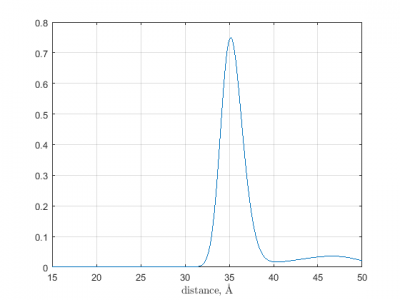
Example distance distribution.
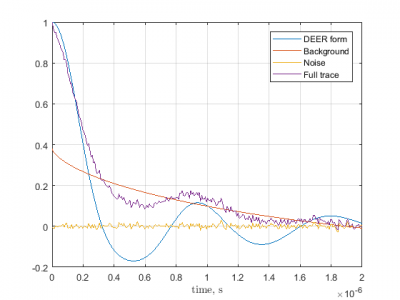
DEER trace and components for example distribution.


Notes
- As the dipolar modulation frequency is a cubic function of the inter-spin distance, a scaling relationship exists betweent the distance range and the duration of the DEER signal.
\[\frac{t_A}{r_A^3}=\frac{t_B}{r_B^3} \]
- An important factor when generating data for training is the dynamic range - the ratio between the longest and shortest distances represented in the training set.
- The training set DEER traces should be sufficiently discretised (parameters.npoints) to reproduce all frequencies present.
See also
netset_curate.m, train_one_net.m
Version 2.2, authors: Ilya Kuprov, Steve Worswick, Gunnar Jeschke
