deer_lib_gen.m
Generates a library of distance distributions and corresponding simulated primary DEER traces using the parameters supplied, in a 4 step process:
- The batch of simulated spin label distributions are generated as a randomly selected number of skew normal distributions.
- \[p(r)=\frac{2}{\sigma \sqrt{2 \pi}}e^{- \frac{(r-r_0)^2}{2 \sigma ^2}} \int_{- \infty}^{ \alpha \left (\frac{(r-r_0)}{\sigma} \right )} e^{- \frac{t^2}{2}}dt \]
- The DEER form factor d(t) is computed from the distributions using the kernel for DEER in the presence of exchange coupling (Equation 2 in our paper).
- \[\gamma(r,t)=\sqrt{\frac{\pi}{6Dt}} \left [ cos [(D+J)t]FrC \left [ \sqrt{\frac{6Dt}{\pi}} \right ] + sin [(D+J)t]FrS \left [ \sqrt{\frac{6Dt}{\pi}} \right ] \right ] \]
- Simulated background, b(t) and additive noise tracks n(t) are mixed with the DEER form factor;
- \[s(t)=[1-\lambda+\lambda d (t)]b(t)+n(t) \]
- the background signal is generated as a stretched exponential function,
- \[b(t)=exp \left [ -(kt)^{n/3} \right ] \]
- the noise track is uncorrelated, representing the instrumental noise expected during the indirect acquisition in the DEER method.
- The distance distributions and DEER traces are then scaled to the neural network activation range:
- distributions are uniformly scaled to 0.75,
- DEER trace are scaled and shifted to make the first and last points equal to 1 and 0 respectively.
For each pair in the training set the variables controlling the shape of the distance distribution; the amount of exchange coupling to include; the form of the background contribution to the signal; and the level of noise are randomly selected from the ranges provided in the parameters structure.
Contents
Syntax
deer_lib_gen(file_name,parameters)
[output arguments]=deer_lib_gen(file_name,parameters)
Arguments
    file_name      - name of output *.mat file, include
		     a full path to specify the output
	   	     location.
    parameters     - training set parameters, with fields
		     described here.
Outputs
The function output arguments are listed below, in the order expected:
    time_grid      - the time axis for the DEER traces, in
		     seconds. A row vector.

    dist_grid      - distance grid for the distributions,
		     in Angstroms. A row vetor.

    dist_distr_lib - all distance distributions, a horizontal
		     array of column vectors.

    deer_ffact_lib - all DEER form factors, a horizontal
		     array of column vectors.

    background_lib - all background signals, a horizontal
		     array of column vectors.

    deer_trace_lib - all primary DEER traces, a horizontal
		     array of column vectors.

    noise_line_lib - all noise tracks, a horizontal array
                     of column vectors.

    exchange_lib   - exchange coupling scalar used to in
		     generating each trace, a row vector.

    parameters     - the parameters structure, unchanged.
The function may be called with a specified file name (including a full path), in which case the output arguments are also saved in a .mat file at that location. If the file name input is left empty then the database is not saved.
file_name=[];
Examples
The example below first loads the netset parameters from the ensemble optimised for all peak widths, and then generates a library of 1000 trace/distribution pairs. The example may be run from the examples/deernet/ directory.
	% Load the training set parameters
	run('net_set_any_peaks/netset_params.m');

	% Specify number of traces to produce
	parameters.ntraces=1000;

	% Set the training database name
	file_name='dlg_example_set.mat';

	% Generate the training library
	[time_grid,dist_grid,dist_distr_lib,...
 	deer_ffact_lib,background_lib,deer_trace_lib,...
 	noise_line_lib,exchange_lib,parameters]=deer_lib_gen(file_name,parameters);
This example will add the output libraries to the MATLAB workspace, as well as saving them in the working directory as "dlg_example_set.mat"
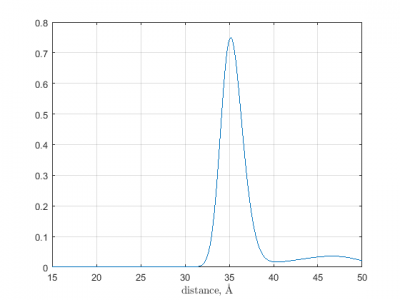
Example distance distribution.
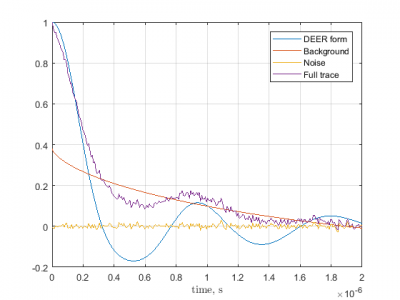
DEER trace and components for example distribution.


Notes
- As the dipolar modulation frequency is a cubic function of the inter-spin distance, a scaling relationship exists betweent the distance range and the duration of the DEER signal.
\[\frac{t_A}{r_A^3}=\frac{t_B}{r_B^3} \]
- An important factor when generating data for training is the dynamic range - the ratio between the longest and shortest distances represented in the training set.
- The training set DEER traces should be sufficiently discretised (parameters.npoints) to reproduce all frequencies present.
See also
netset_curate.m, train_one_net.m
Version 2.2, authors: Ilya Kuprov, Steve Worswick, Gunnar Jeschke
